A Bitter Independence: The Story of Johnson Neal

As a genealogist, I’ve spent decades searching for the stories of my ancestors, especially those whose lives were almost erased from history. Each discovery is both a victory and a heartbreak because the documents that prove their existence often reveal the injustices they endured.

This Fourth of July, as America celebrates freedom, I find myself thinking about Johnson Neal. Though I haven’t yet proven he is biologically connected to my family, I consider him part of our story. He was enslaved in Franklin County, Georgia, by a man named John M. Neal – the same name I found linked to my direct maternal ancestors. His life and service offer a stark contrast to the ideals of liberty we honor today.


Born Into Bondage, Fighting for Freedom

Johnson was born enslaved in Franklin County, Georgia. No record of his birth exists; like so many others born into bondage, his age was never documented. In his later years, Johnson swore under oath that he had no record of his age and could only name his master – John M. Neal – as proof.

As General Sherman’s army carved a path of destruction through Georgia in his infamous March to the Sea, enslaved people like Johnson watched plantations burn and felt the first tremors of freedom.

But liberation was uneven. Some enslaved men followed Sherman’s troops, seizing the chance to escape. Did Johnson do the same? Or was he carried North by other means, perhaps as a servant or laborer, until he found the opportunity to enlist?

His records are silent on how he reached Wisconsin, but there, he was drafted into the 51st Wisconsin Infantry, Company C – one of more than 450 serving in the state.


The Courage of Wisconsin’s Black Soldiers

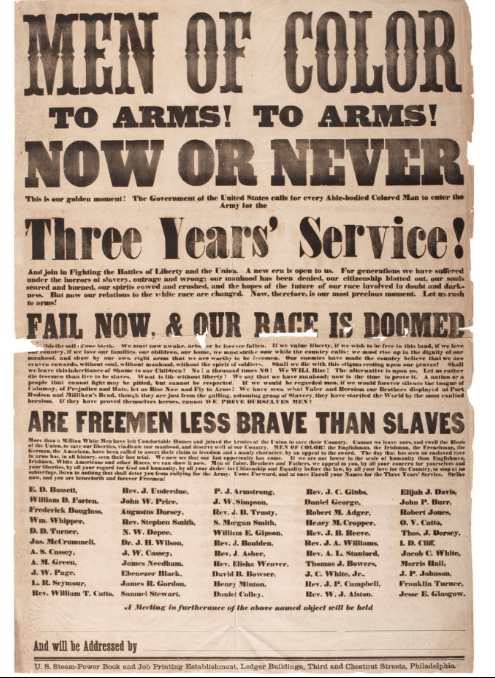
When the Civil War began, African Americans were barred from serving as soldiers. Some worked as non-combatant laborers in Union regiments. That changed on January 1, 1863, when President Abraham Lincoln’s Emancipation Proclamation made it possible for Black men to enlist. Over the next two years, 272 Wisconsin men of color joined the Union army. Another 81 Black men from other states, enlisted in place of white draftees, were credited to Wisconsin’s rolls, bringing the total number of Wisconsin’s Black troops to 353.

These soldiers were often relegated to labor-intensive duties: guarding railroads, repairing supply lines, and policing the Reconstruction South. Yet they wore Union blue with pride, staking their claim to liberty in a country that had long denied their humanity.
Courtesy of the family of Frederick Douglass; US Department of Defense; https://www.defense.gov

A Life of Struggle and Resilience

After the war, Johnson settled in Covington, Tennessee, where he lived with his family until 1906. His health began to fail, and he entered a Soldiers’ Home in Ohio before transferring to Wisconsin’s Northwestern Branch of the National Home for Disabled Volunteer Soldiers in 1907.

Black veterans were welcomed at the National Home, but segregation still ruled its halls. African American members lived in separate quarters and ate at different tables. By 1900, only 2.5% of veterans in the National Home system were African American, even though nearly 10% of Union soldiers had been Black. For many, the prospect of segregated facilities and the bitter reality of racism discouraged them from seeking refuge there.

In 1910, Johnson was one of only about ten African American veterans among more than 2,000 men at the Milwaukee Soldiers’ Home. Surrounded by men who could not have known the double battle he had fought – against the Confederacy and against racism – he must have felt profoundly alone.
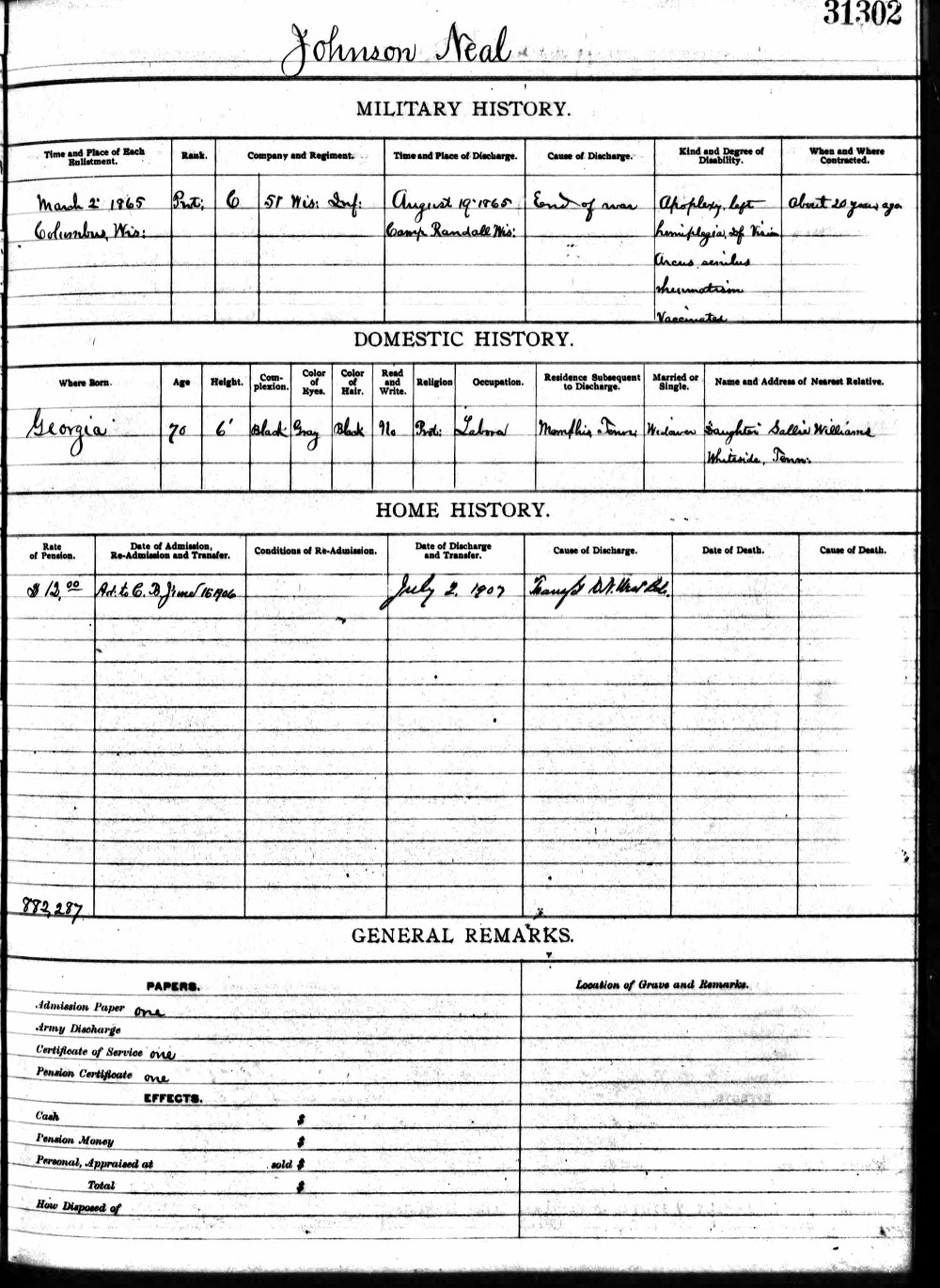
The National Archives in Washington, DC; Washington, DC, USA; Historical Register of National Homes for Disabled Volunteer Soldiers, 1866-1938; Series: M1749

The Pension Fight

When Johnson applied for the pension he had earned through service, he faced a cruel irony. Sworn under oath, he explained that he could not provide proof of his age because he had been born enslaved and no record of his birth existed. To receive the recognition he had earned as a soldier, Johnson still had to rely on the words of the man who once owned him.

In 1912, Johnson chose to leave the Milwaukee Soldiers’ Home. His discharge papers read simply “OR”: Own Request. He returned South to live with his daughter, who cared for him in his final years and later paid for his burial when he died in 1915.

After his death, his daughter took up his fight, writing letters to the government, hiring a lawyer, and refusing to let her father’s service be erased.


A Legacy of Freedom Deferred

As I read the letter that first named him as a slave, I feel the weight of it all. For decades, I searched for proof that Johnson was part of my family’s story. Finding that letter was a triumph, but it was also a reminder that men like Johnson had to claw their way toward recognition – first as soldiers, then as citizens, and finally in the fragile memories of descendants like me.

Today, Johnson lies buried in Southern soil, near the daughter who loved him fiercely. And as fireworks light up the Wisconsin sky, I think of him marching in Union blue, a man who crossed Georgia’s burning fields seeking freedom, only to find it deferred.

Find Out More!

Are you interested in more stories like Johnson Neal’s – stories of resilience, discovery, and the hidden lives of our ancestors?

👉 Subscribe to GeneaGrams, my genealogy newsletter, for exclusive insights, tips, and family history case studies!
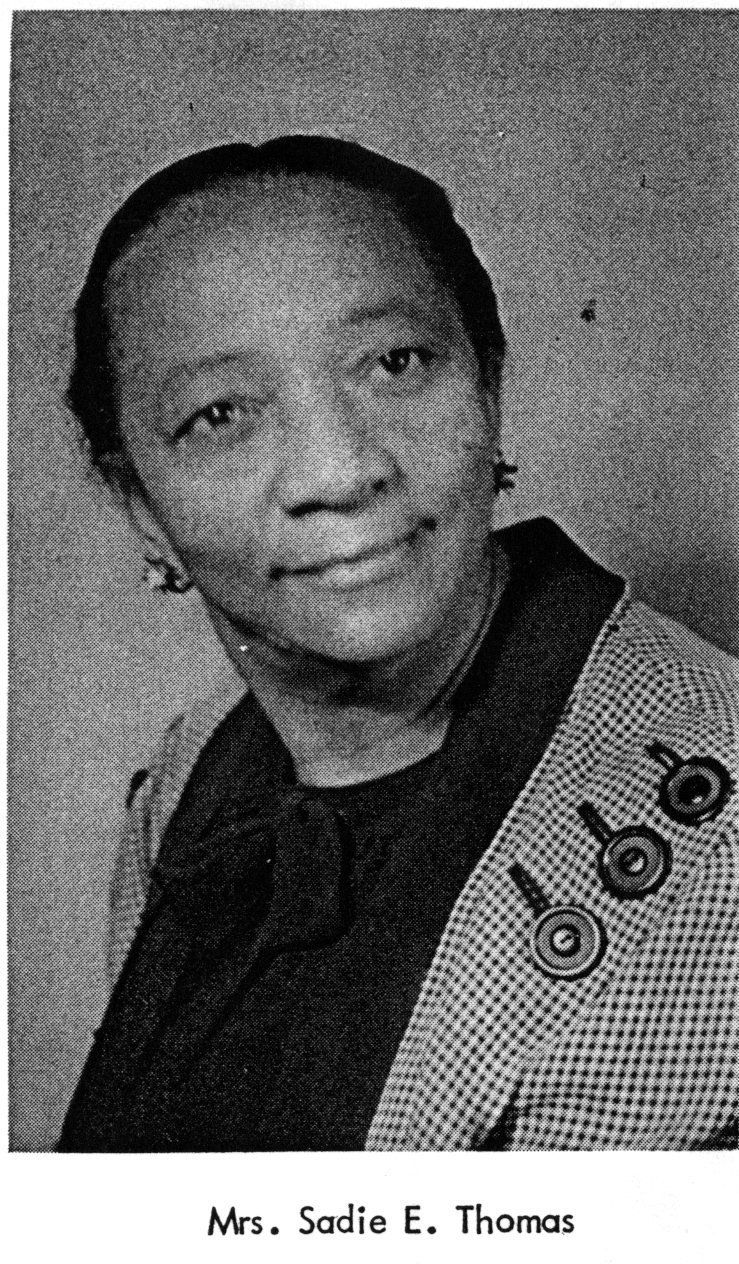
Sadie Elizabeth Robinson Thomas — The Woman Behind The Park

On this Juneteenth, I’m reflecting on the legacy of my beloved Aunt Sadie Robinson, who was born in Bryan, Texas – a place just miles from Galveston, where freedom was finally proclaimed to the last enslaved people on June 19, 1865.

Aunt Sadie was a lifelong Bryan, Texas resident and was very active in the community and public school system. She carried the wisdom of generations before her, and her life was a powerful testament to resilience, grace, and perseverance. 

As we celebrate freedom today, I honor her memory and the countless other Black women like her -whose names may not be in history books, but whose courage helped pave the way for us all.

This Juneteenth, I remember Aunt Sadie not only for who she was, but for the history she represented and the future she helped shape. 

That in itself is the story – a woman who quietly and consistently shaped her world through education, mentorship, and advocacy.


Remembering Sadie Robinson Thomas

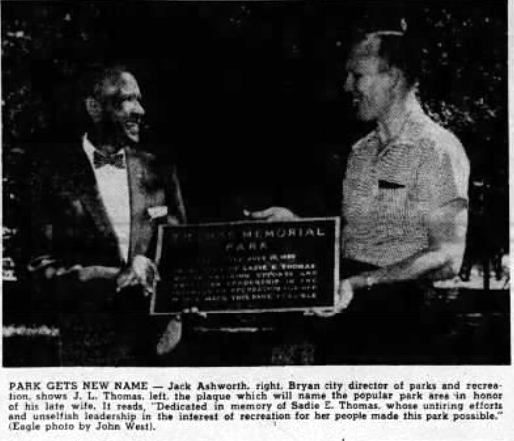
On a summer day in Bryan, Texas, children once gathered under shade trees, laughter echoing through the playground of what was then called Eastside Park. But in 1959, two years after her passing, that park was renamed Thomas Memorial Park – a rare and powerful tribute to a Black woman whose quiet leadership shaped an entire community.

Sadie Robinson Thomas graduated cum laude from Wiley College in Marshall, Texas, an extraordinary feat for a Black woman in the early 20th century South. She pursued advanced studies through correspondence courses at the University of Chicago and the University of California before earning her master’s degree in English from Columbia University. While teaching full time, she also raised three foster children and served as a matron of the Eastern Star, leading Bible studies and community initiatives with grace.

Alongside her husband, Lev Thomas, Sadie helped lead the fight for school integration in Bryan – an effort that succeeded in transforming educational access for generations of Black children. Her advocacy extended to public health, where she led a drive that secured the appointment of the state’s first Black health nurse.

I imagine her standing at the front of a crowded classroom – shoulders square, eyes kind, voice calm. To her students, she wasn’t just a teacher; she was a second mother. To her neighbors, she was a trusted listener and moral compass. And to her community, she was a force.

In 1959, that force was honored when the city renamed the park in her memory. Her legacy, once rooted in quiet service, became quite literally part of the landscape.

Sadie E. Thomas Memorial Park Dedication

Want to Know How I Uncovered Sadie Robinson’s Hidden Legacy?

The story you just read is only the beginning. In my GeneaGrams newsletter, I take you behind the scenes to show exactly how I pieced together Sadie’s journey—from newspaper archives to school board records and long-forgotten community bulletins.

Subscribe to my Substack now to learn the step-by-step research strategies I used—and discover how you can uncover the hidden stories in your own family tree.

NEW!! Genealogy Insider Newsletter

Join GeneaGrams and get exclusive monthly research tutorials, tools, and expert tips designed for beginner and intermediate family historians.


For years, I’ve been sharing the stories, strategies, and discoveries from my own genealogy journey right here on the blog—combing through census records, decoding family photos, and helping you navigate the rich (and sometimes messy) paths of ancestry research.

But let’s be honest: the deeper you go, the harder it gets.

That’s why I’m thrilled to introduce GeneaGrams, my new monthly newsletter designed to take you beyond the blog and into the heart of advanced family history research.

While the blog will still offer free stories and tips, GeneaGrams is where I’ll be sharing the tools, techniques, and case studies I usually reserve for clients, along with exclusive resources that will help you solve tough mysteries, organize your research, and tell your family’s story with more clarity and confidence.

Here’s what you’ll get inside GeneaGrams:

  • 🔎 Real case studies that walk you step-by-step through brick wall breakthroughs
  • 📁 Downloadable templates and worksheets to keep your research focused and productive
  • 💡 Deep-dive tutorials on advanced methods like cluster research, DNA triangulation, and migration mapping
  • 🧬 Storytelling strategies to turn your data into legacy
  • 🗣️ Q&A and behind-the-scenes insights from my own research files

You’ve already seen what’s possible with free content – now imagine what you could accomplish with a guided path and premium resources at your fingertips.

If you’ve found value in this blog, GeneaGrams is your next step.

👉 [Click here to learn more and subscribe to GeneaGrams now.]

Let’s keep growing, digging, and honoring our ancestors – together.

With gratitude,
RootsGenie
Genealogist, Writer & Family History Storyteller


Intentions

Retrieved 2023, January 1, from http://www.dictionary.com

We all seem to start the New Year with the best intentions. Resolutions to become a better person, or accomplish a goal. In genealogy research, you need to start with a plan or you end up wasting time and money. By the end of the year, you can reflect on those successes or failures to determine if you should shift your focus, or maybe start from scratch.

When I came back to my blog at the end of 2022, I realized I hadn’t been here since 2019. My intentions in my last post were to come back regularly to share my family history with likeminded genealogists. A lot has happened since that I will share more about in future posts, but I can say that the Covid pandemic has made my life completely different in the past three years. So much so that I didn’t even realize that three years had passed! But my intentions were completely honest.

My plan was to write, and write as often as possible to get myself back in the habit. But like the quote says, tell Him about your plans! So I will say I am striving to do the best I can, and I won’t beat myself up if I fail. I would like to post at least twice a week, not including social media. I’m hoping that you will hold me accountable if I try to disappear again. The only way to make it through tough times is to push through it. Here’s to success in 2023!

New Year, New Look!

I’ve been neglecting you, and my ancestors have been letting me know it. I decided that I need to refocus my energy on this blog. Not just sharing research, but sharing stories that bring my ancestors back to life. So I’ll tell you what inspired me to make this change:

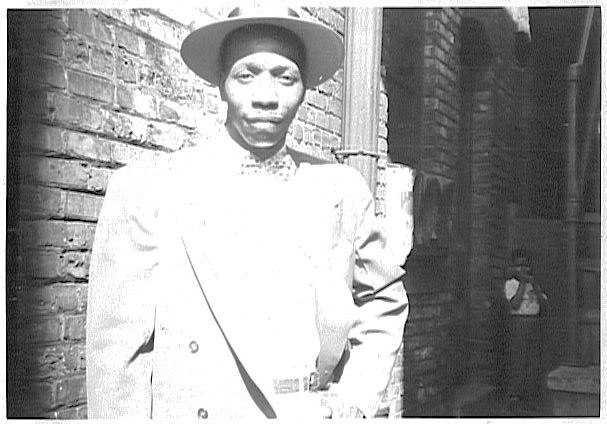
Anyone that rides with me knows that I never take off right away at the light. A few weeks ago I was coming up to a red light and it suddenly turned green. Something kept telling me “don’t speed up, go slow”, and I never pressed on the gas. It was almost like I could feel something pulling me back. By the time I got to the intersection someone came barreling through the red light, just missing us. Had I taken off at regular speed I’m positive that my passenger and I would have been seriously injured, or killed. I had no idea why I had such a strong urge to slow down, but I later learned it was the anniversary of my grandfather Raymond Neal’s passing. Now I understand it was his presence I felt, and I have to holla back I hear you Pop! (and was it coincidence that his favorite singer, Nancy Wilson, passed later on that day?)

So I challenge everyone who reads this to acknowledge those whispers, and the hairs that raise on the back of your neck. That’s your ancestors pleading with you to remember them, and call their name.

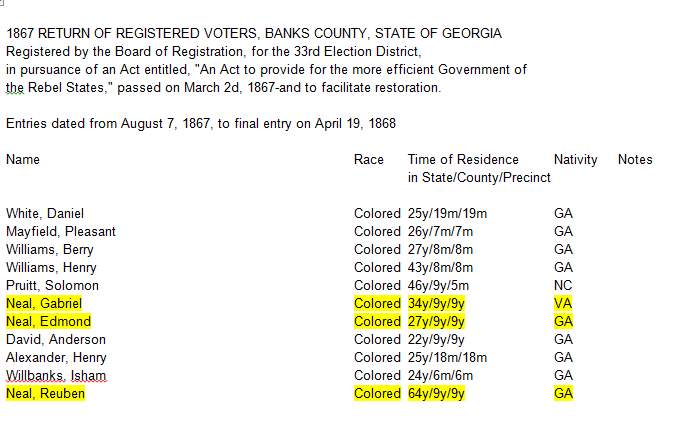
neal, raymond
Raymond Neal circa 1952, Milwaukee, Wisconsin. (My uncle Delmar hiding in the background).


Susie Holbert-Mosaic Templars of America (Part 1)

I can’t say enough about the kindness of strangers. I use the Findagrave.com website quite often to search for ancestors. If I’m lucky there may be a picture, a biography or at the least a link to other relatives in that cemetery.
In this instance, I was looking for my Aldridge family that I found in the Rusk Cemetery in Boley, Okfuskee County, Oklahoma. I requested photos from a local volunteer and I waited. In the meantime, I did more digging and found I had another ancestor there: my 3rd great-grandmother, Susie (Crenshaw) Holbert. So I emailed my wonderful volunteer, Angela Dionne, to ask if she could look for Susie’s final resting place as well. I had no idea of the wealth of information I would soon find out about my ancestor, and the history lesson to come.
Angela explained that Okfuskee County had a lot of black cemeteries that have not been documented.  Apparently, there was someone who took the time to add lists but not pictures, so they were in the process of trying to photograph as much of the cemetery as possible. Problem was a lot of the graves only have a rock, or a headstone that is no longer readable. I kept my fingers crossed, but I wouldn’t hear back from Angela for a while.
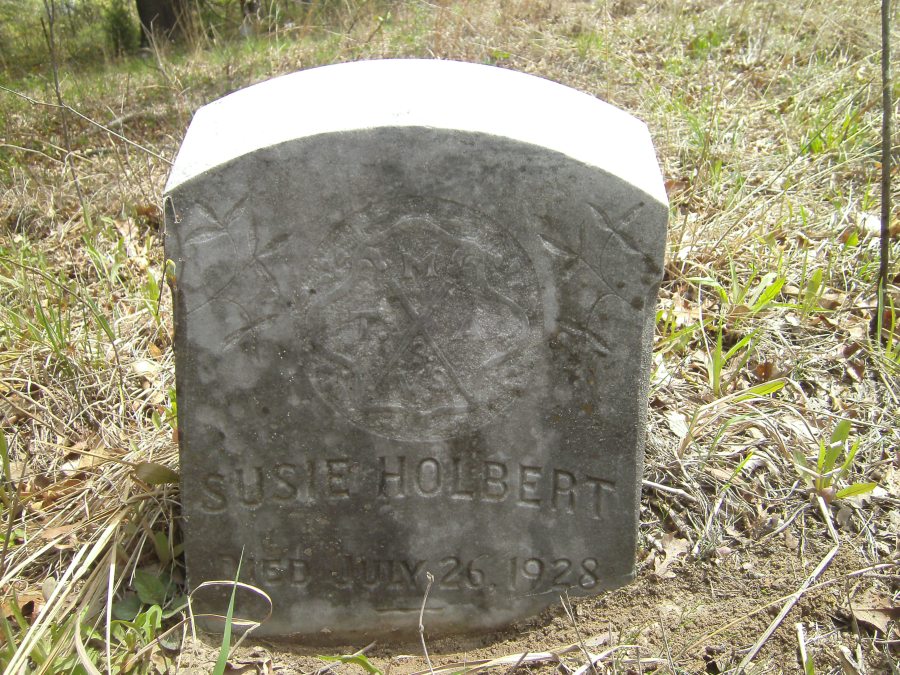
Then one day out of the blue, I get this in my email:
SANYO DIGITAL CAMERA
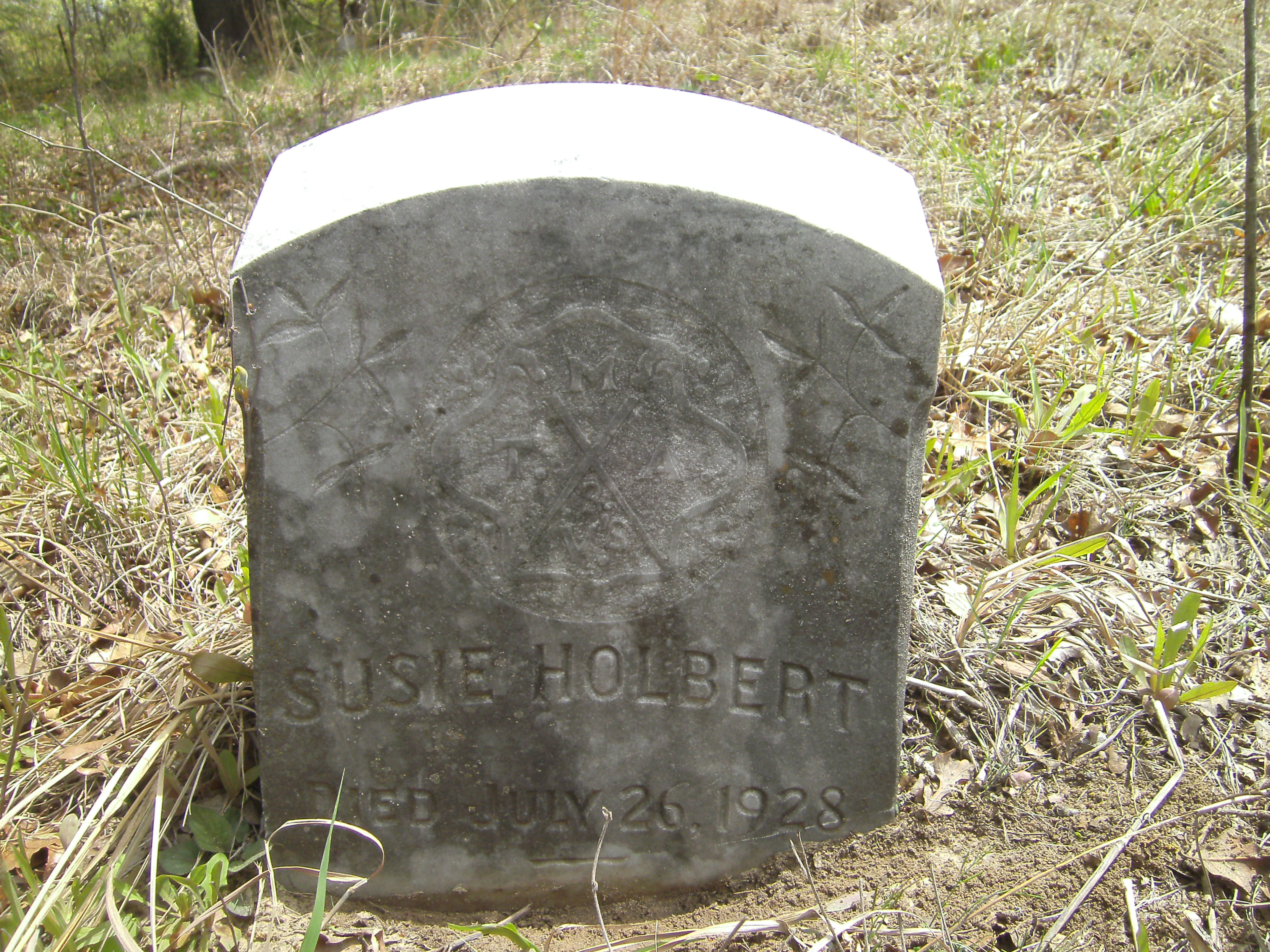
As you could guess I was ecstatic enough to have a picture of her headstone and a likely date of death. But if you look closer, you can see there is a symbol and inscriptions above Susie’s name. I emailed Angela again to thank her for the picture and to ask her if she knew anything about the symbols. She said she would go back to the cemetery and take another picture of the headstone to see if she could get more detail. So I have to wait again, but I am so grateful to Angela for making another trip in the Oklahoma summer heat!
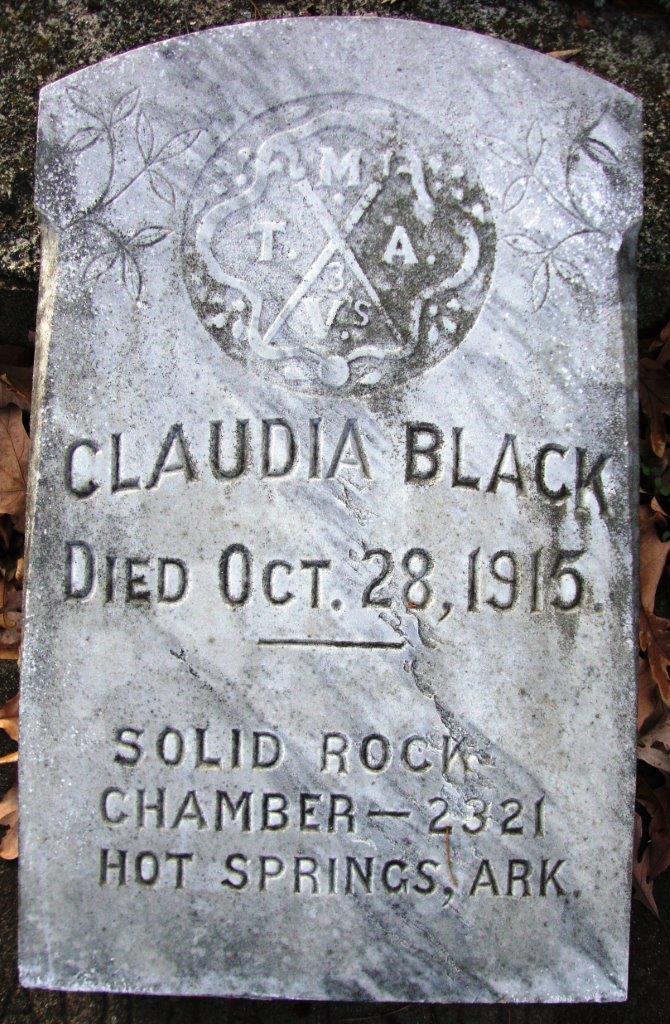
While I waited, I tried to make the picture as big as possible. In the center it looked like some sort of Masonic symbol, but I couldn’t make it out clearly. I searched for anything that looked similar on Google images, then one day I found something that looked familiar:
MTAMarker
There were similar markings, and there is more detail at the bottom of the stone. I learned that it is not a Masonic symbol, but the marker of the Mosaic Templars of America, an organization founded by two former slaves in Little Rock, Arkansas in 1882. But how did my grandmother end up with this marker in Oklahoma? Stay tuned to Part 2 to learn more about my incredible discovery!

FGS 2015-Connect. Explore. Refresh.


#FGS2015
#FGS2015

I have been to many local genealogy conventions, but I have never been to one expected to bring in crowds of thousands from all across the globe. That’s why I am super excited to be one of many social media ambassadors at this year’s FGS conference, sharing my experience as a national conference “newbie”. In this regard, my perspective may be slightly different from the others, so my first post in this series will reflect what this year’s theme means to someone like me.

Genealogists understand each other: they don’t think I’m strange because I collect death certificates and obituaries, or judge me because I hangout in courthouses and cemeteries in my spare time. Joining my local genealogical society gave me the chance to Connect with other researchers. I have the opportunity to bounce ideas off of others and share my success stories. I can only imagine what I can do with like minds from all over the world! It is such a pleasure to converse with others who share your interests, and I am looking forward to making many new friends, as well as finally meeting some in person.

One benefit of forming these alliances within the genealogical community means I don’t always have to sit in dusty courthouses looking for records, or scroll microfiche for hours in the library. There are wonderful volunteers who digitize and transcribe records, and today there are many new databases being released every week. At the conference, I can Explore all of the new technology and learn how to best incorporate it into my own research. I have learned how to use my time more efficiently, and it helps me stay organized. Plus, I can spare my embarrassment when I scream out loud from finding that long, lost ancestor!

I have to admit that even in the midst of all my excitement, the most important part of attending the conference is to help me stay motivated. I have been researching and documenting my family history for more than 20 years, and there are times when I really feel the burnout. My eyes have gone tired from trying to decipher old handwriting, my brain is tired from trying to make sense of records that just don’t seem to match up with anything. I am going to use this event as a way to Refresh my way of thinking, gain a new outlook on my research, and come back home to share what I have learned with others. So considering all the knowledge I will gain, and connections I can make, this is truly an opportunity I can’t afford to miss!

“One Lovely Blog Award”

As I am working on this month’s post for Breast Cancer Awareness Month, I received wonderful and unexpected news from a friend and fellow genealogy blogger. Denise Muhammad, author of  They Came From Virginia, nominated me for the One Lovely Blog Award.  I visit Denise’s blog often, her style of writing is engaging and her stories always inspire me to go back and check a few more sources for my own research. Best of all, she shares some fantastic pictures with her posts!

one-lovely-blog-award_thumb


Here are the rules for this award:

  1. Thank the person who nominated you and link to that blog
  2. Share Seven things about yourself
  3. Nominate 15 bloggers you admire (or as many as you can think of!)
  4. Contact your bloggers to let them know that you’ve tagged them for the One Lovely Blog Award

 
Seven Things About Me:

1. I was born and raised in Milwaukee, Wisconsin but I have lived in California, Texas and Illinois

2. I have been researching my family roots for more than 20 years

3. Besides being a genealogist, I work as a freelance writer and journalist

4. When I have free time, I enjoying reading and crossword puzzles

5. I volunteer as a breast cancer advocate, and have lobbied in Washington D.C.

6. I studied classical ballet and modern dance for 15 years

7. I play the piano, but I had to play the oboe in band (imagine that!)


It was difficult to choose, there are so many great blogs out there. Here are 15 Bloggers that I Admire:

1. Claiming Kin by Liv Taylor-Harris

2. Saving Stories by Robin Foster

3. My Ancestor’s Name by Angela Walton-Raji

4. My Blessing That Is SCD by Humbly Blessed

5. Scuffalong:Genealogy by Lisa Henderson

6. Taneya’s Genealogy Blog by Taneya Koonce

7. Ancestors In The Present by Tammy Ozier

8. My Journey: Breaking Down The Walls by Nique Starpg

9. Genealogy With Valerie by Valerie Hughes

10. Adam Henig by Adam Henig

11. Genealogy Adventures by Brian Sheffey

12. Pieces of Me: Bayou Teche Genealogy by Stephani Miller

13. Between the Gate Posts by Linda Rudd

14. My Roots My Blog by Tasia

15. Arkansas Roots: The Stories of my Family by Jamila Sloan Barahona

For those on my list, if you have already been nominated I’m pretty certain that you don’t have to nominate a group. This list could be much longer, as I had a hard time narrowing it down to 15. There are so many bloggers that I follow that inspire me, and I hope that they will continue sharing their stories with us in the future.

Contact Bloggers
I will be contacting the 15 bloggers on my list, unless they see this post and contact me first.  Thanks again to Denise for the nomination. I feel very proud to be included in your list of lovely blogs!

Tuskegee Airmen- Bertrand Holbert

The 99th Pursuit Squadron, later dubbed the Tuskegee Airmen, was activated in March of 1941. In honor of this important anniversary I was drawn back to my own research and I found a possible connection to the prestigious airmen in my paternal Holbert line. Of course, with every new discovery there are always more mysteries that come along to challenge your findings.

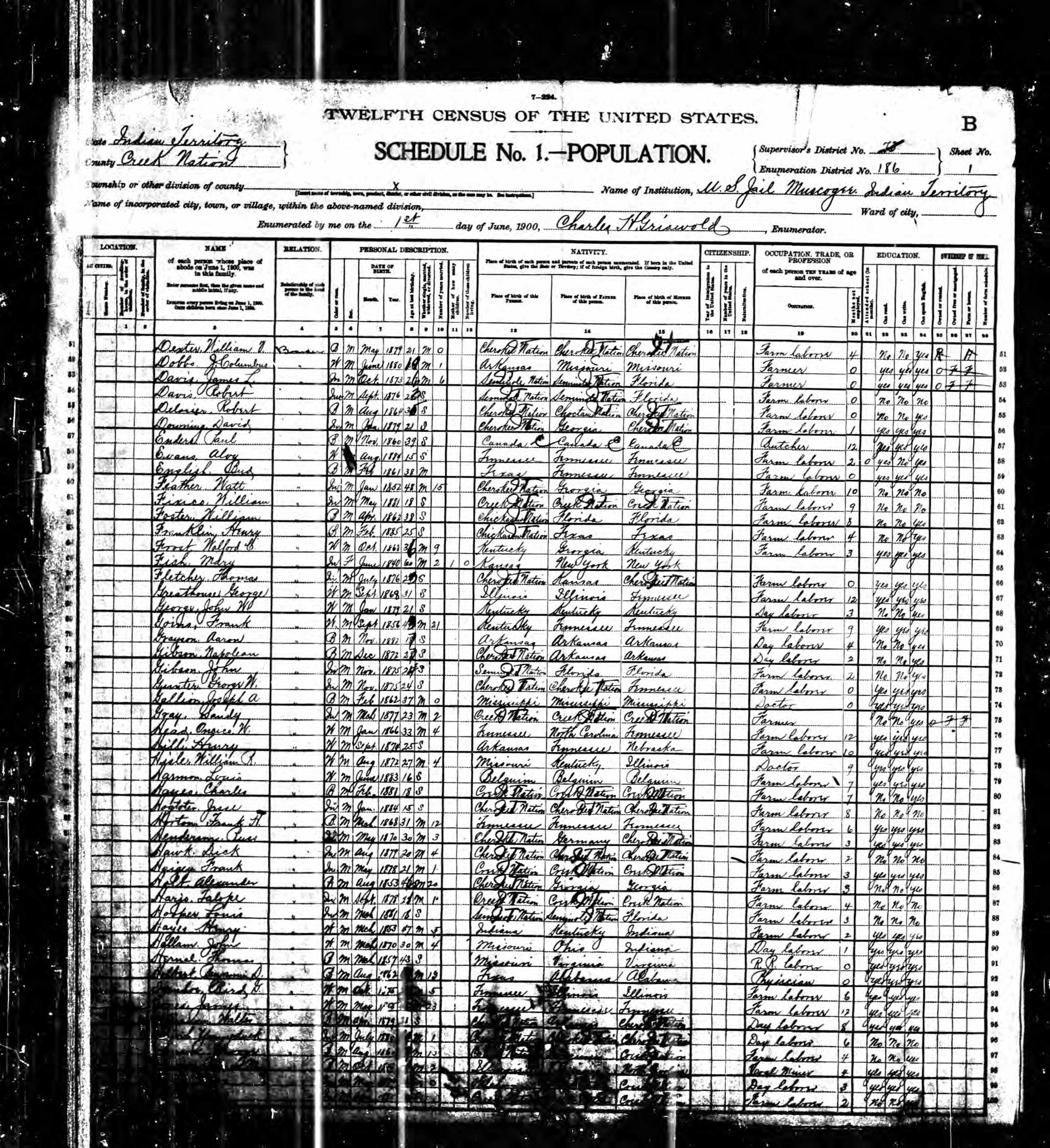
Much of my research of the Holbert family reveals a long line of educators, and that tradition continued in the line of my 2nd great grand uncle, Benjamin D. Holbert. On the census records from 1870 and 1880 he is listed as the son of Franklin and Susan Holbert, living in Cherokee, Texas. In 1890 I found a city directory from Waco, Texas that lists a Benjamin D. Holbert as a colored teacher. The only record I found for anyone matching his birth date in 1900 was in the U.S. Jail in Muscogee, Oklahoma, Indian Territory. It states he was born in Texas and both of his parents were born in Alabama, which matches my uncle, but it lists his occupation as “physician”. This census also states Benjamin has been married for 13 years. Although I don’t find any more records for him after 1900, there is a marriage record for a B.D. Halbert and Annie Marie Estell in nearby Mclennan, Texas dated December 29, 1886 (14 years from that 1900 census). Coincidence?

1900 US Federal Census-Township 1, 2, and 3, Creek Nation, Indian Territory

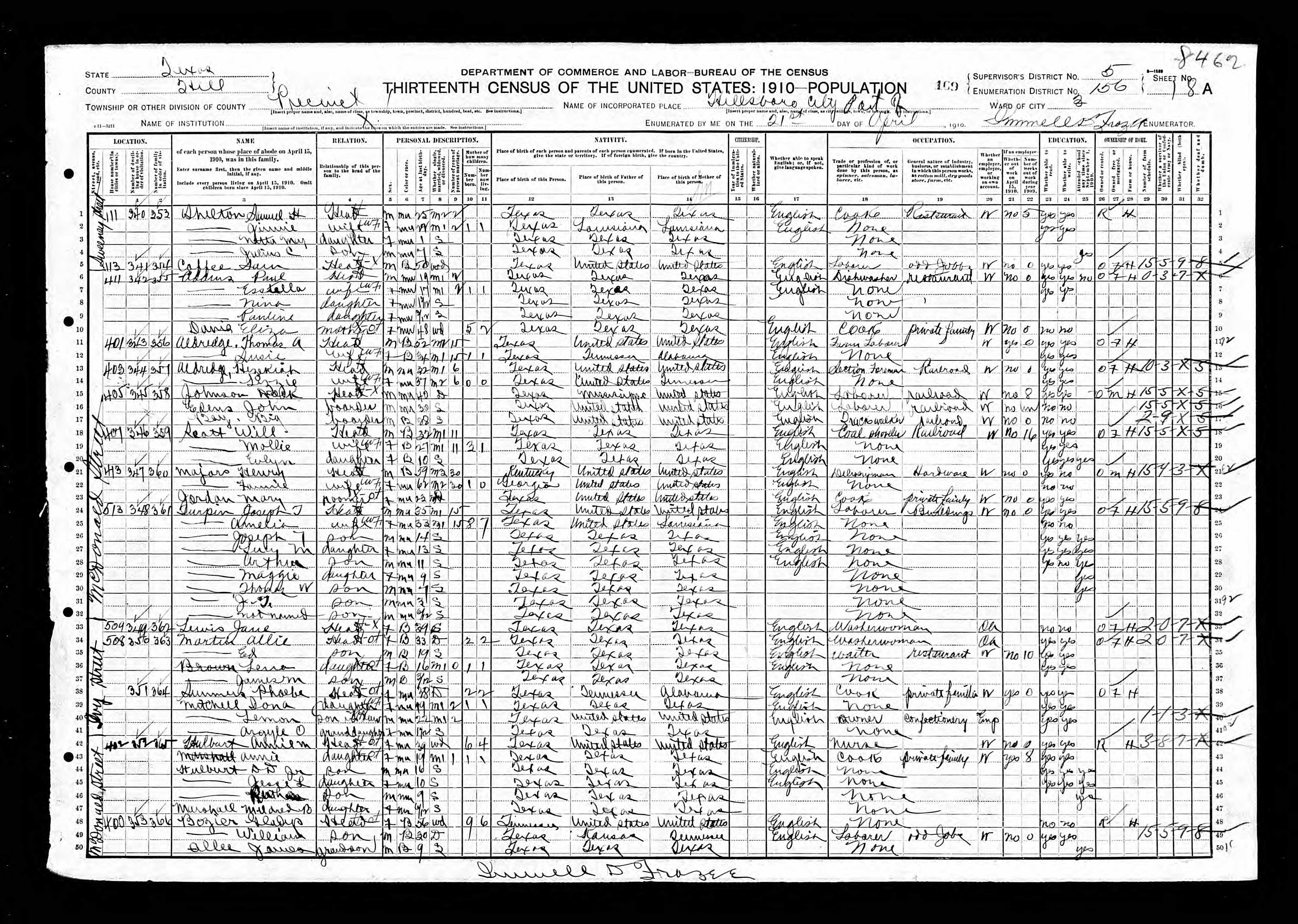
Ann Marie Estell was born in Waco, Texas around 1868. I do not find her on a 1900 census, but I do have a city directory from as early as 1902 that puts her in Waco, Texas. In 1910 she is living in Hill County, Texas with four children: Annie, Benjamin Jr, Jessie and Ruth. All of the children’s death certificates confirm their father’s name as B.D. Holbert.

1910 US Federal Census-Hillsbro Ward 3, Hill, Texas

The only son, Benjamin Jr., is living with his wife, Sarah, on the 1928 city directory in Dallas, Texas. He is using the initials B.D. Holbert from this point forward. However, on the 1930 census he is now living in Seminole, Oklahoma. He is widowed and is boarding in the household of William and Emma Simmons. His current age, age at first marriage, and his occupation of public school teacher match my ancestor’s information. On the 1940 census he is still in Seminole, Oklahoma but is now married again and a principal in the public schools. Was that an error to list him as widower on the last census? If so, why was he living apart from his family?

Sarah Cummings Holbert is still living in Dallas, Texas with her two children, Bertrand and Kenneth, on the 1930 census. She also states that she is widowed. According to her death certificate she had remarried and was now Sarah Sears. I have not yet been able to find her or her children on the 1940 census, but I do know that she was also a public school teacher.

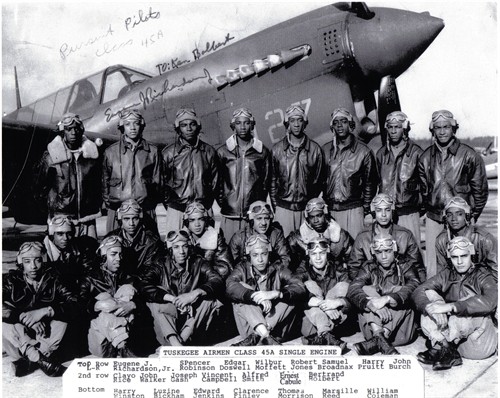
It is Benjamin and Sarah’s son Bertrand Holbert who was a member of the Tuskegee Airmen Class 45A Single Engine Pursuit Pilots. I don’t have the proof I would need to make this a positive match even though there are relatives who have listed them in their family tree. I have so many ancestors named Benjamin, B.D., and Annie to keep them all straight. I need to order the death certificates of all the names that I don’t have already, and hopefully they will clear up some of the confusion.

Tuskegee Airmen Class 45A Single Engine Pursuit Pilots

Image
Class 45A, fighter pilot (single-engine) group graduation class photo, with P-40 plane in background (courtesy of Sam Broadnax).

That would be my cousin Bertrand Holbert, 2nd row, last one on the right.

Photo retrieved from http://www.military.com/Content/MoreContent1/?file=BH_Tuskegee